Showing posts with label encouragement. Show all posts

Wednesday, August 14, 2013

Subjectivity is Out of Control!

Last night Danielle and I did a live Google Hangout with the amazing WriteOnCon! (Seriously, amazing doesn’t even cover it! It is still going on today – go here for the best writer’s conference on the internet! And bonus: it’s free!) The attendees pitched their books on Twitter, which is incredibly challenging at only 140 characters, and we had our live reactions and advice aired for the entire world to see (in fact, it has been immortalized on YouTube and you can watch it here, if you like!)

We had an absolute blast working with the phenomenal team that runs WriteOnCon and were so grateful to all of the amazing writers who came out and took a leap to share what their story is about and have their pitch critiqued live. That takes guts and we got so many amazing entries! 

We talk a lot in the video about what makes a good pitch, so I thought instead I would talk today about subjectivity and how it relates to your path in publishing. I’m only going to touch on the second topic briefly, if you are looking for a far better explanation of your publishing path choices please read The Daily Dahlia post on it here!

So while the list of things in publishing that are out of a writer’s control is extensive, I think one of the greatest is subjectivity. When you think about it, every single step of the process is subjective: From your first thoughts about your own work, to what you change based on your crit partners’ thoughts, to what agents think, to what editors think, and all the way down the line and including what readers think! Subjectivity is completely beyond control, even internally for most! People like what they like, connect with what they connect with, and on the flip side don’t like what they don’t like. Sometimes there are really strong eloquent reasons for these feelings and other times it’s just a feeling, no explanation. 

The important thing to remember while lamenting your inability to control subjectivity (or maybe that’s just me…) is that, with a few notable exceptions, NO ONE IS WRONG. As an editor, I receive pitches and manuscripts from agents on a daily basis and how I feel about them is dependent on an infinite number of factors including, but by no means limited to: What do I feel like reading right now? What was the last thing I read in this genre? Did I love that or hate it? Is this a concept that sounds unique to me? Are the comps titles/movies/etc. things I recognize and like? Did I eat breakfast this morning? Is it raining outside? The list could seriously go on forever.

For this reason I always give myself multiple days to consider submissions AND have numerous members of my team read books that I’m interested in to make sure that the things that are sparking my interest about this particular book are going to do the same OUTSIDE of my head. Sometimes I get feedback that is perfectly in line with how I was feeling and sometimes it’s completely the opposite. But more often than not, it falls somewhere in the middle and the acquisitions team gets involved to add their business-related thoughts to the decision. It’s a team effort, and it has to be, because when the books go out into the world they are going to encounter a vast number of wonderful readers and we want to find the books that those readers are going to love.

That being said, there are non-work related, published books I’ve read and loved like they had been written for my soul alone that other people thought were rubbish. And there are books that’s I’ve thought were terrible and other people felt as though they are the answer to all of life’s most pressing questions. And all of the things that come into play about how I feel about a submission and more play into how a reader feels about a book. I have definitely had books that I DNF’ed because I just wasn’t feeling them, that later I read and adored. It’s all about timing and mood. Both things out of an authors’ control. 

The best thing you can do? Write the most amazing book you can! There are books out there so incredible they blow this entire post out of the water because they transcend timing and mood and are just ALWAYS amazing. They are the books that readers go back to again and again to get them out of a reading slump or to remind them of how amazing they felt the first time they read it. And writing that amazing book is totally within the author’s control! (Bottom line: YOU CAN DO IT!)
The last thing I want to mention is your publishing path with regard to subjectivity. Just like no two books are exactly the same, no two publishing paths are going to be perfectly identical. The number of drafts you write, queries you send, rejections you get, offers you get, etc. is going to vary drastically from everyone else. But it is SO critical to remember that rejection DOES NOT equal failure. 

If you send out 10 queries and get one offer, that doesn’t mean you failed 9 times, it means it took you 10 tries to find the RIGHT person.  The same is true if you send out 500 queries before you get an offer. All that means is that you were waiting to find the RIGHT agent or editor at exactly the RIGHT moment for your book. And when you find that agent or editor that GETS your book and loves your writing, all the other subjectivity and rejections you waded through to get there will fade into the background as stepping stones on your path. 

What are your thoughts on subjectivity in publishing? Do you think there are ways to influence it? Does it affect how/what you write? What are the books that you can read, in any mood or at any time, that are always amazing no matter how many times you read them?

 photo 28b7872b-3312-49d7-b4ac-c797626f4438_zpsd53fd845.jpg


Tuesday, June 12, 2012

The Best Intentions

The road to hell is paved with good intentions.

That's something everyone has heard. I was thinking about writing this morning and how, in all the things that I put into my life, my own path is (more often than not) paved with good intentions. I always have the plan or the drive, but I have so much drive for so many things that there's no way everything can be accomplished. These are my good intentions and they are lining my writing path. My fear? I sure hope the path of my good intentions doesn't lead me to failure.

Good intention: I will encourage all my friends as they write.
I'm listing this first because I spent a large portion of my afternoon encouraging my friends. Now, don't get me wrong: I love encouraging people. It's so joyful to offer up something (even if it's gifs of Tom Hiddleston and Jensen Ackles) to friends who need some rewards/motivation/encouragement. Seriously. LOVE IT. It's the best part of having friends who write: I get to look at hot boys for them. (SEE THE BOYS. CAN YOU BLAME ME??????) Win. 

Yes. I would. Ah..


 Plus, I'm a total encouragement hog, I love getting and receiving, so if me spending time with the hot boy pictures helps them in any way, I'm good. 

I often let myself use my own time seeking out ways to offer encouragement to others. Maybe I'm scared. Maybe I just love my friends so much that I don't think about it. (Both of these are kinda true!) However, I need to make sure my good intention of encouragement doesn't become a crutch that I carry so I don't have to write. Because, let's face it, we writers love excuses to not write. Weirdly.

Good intention: I take on this project because I have time. 
I love editing. Part of this goes to working at Spencer Hill, and part of it to the last point of helping my friends. But I love it. I already have three projects coming out next year for SHP (two in October, one in November) so between that and writing and moving, you know, sleep, I shouldn't be taking on side projects for free or for friends, but YET I AM. 

"Sure, I have time to edits for you by Monday." No, I don't. "Oh, you need a beta--I can help!" No, I can't. "I'd love to do it, sure!" I would, but I don't really have time. Danielle, you're an idiot.

So I have these good intentions, but I take on more and more. I can handle it all. I'm a good multi-tasker, but this is probably a week where nothing will be accomplished in my writing. Because though my intentions are good, my time is limited. 

Good intention: I'll write a blog post.
I have a stack of edits to do, two more waiting, an MS to read, a friend's book to beta (WHICH I CANNOT WAIT FOR!), and a job search to start. But you know the thought that crosses my mind? I haven't blogged since before BEA. I should do that. So here I am.

Oscar Wilde once said, "It is always with the best intentions that the worst work is done."

I really hope the next two weeks aren't killer for me. The last thing I want is bad work. I'm a firm believer in doing things WELL rather than many. But yet, as much as I believe that, my good intentions are stacking up. I need to work harder to make sure they aren't lining a path to failure. 

Does that mean I quit having good intentions? Absolutely not! I'm not going to stop editing, or revising, or writing, or sending hot boy pictures to my friends. There's just no way. So for now, I need to re-evaluate the things I don't need to do--and maybe have a little dog that follows me around and bites me each time I think about saying yes. That would be helpful.


What about you? Do you find yourself taking on too many things, even though your intentions are good? Do you know what those things are? Do you know how to evaluate what things are important and keep yourself accountable? If you don't have this issue, tell me: how do you say no?? 


Tuesday, May 22, 2012

Strength in Cheese Fries and Beth Revis


I had dinner with my friend last night and we always tend to talk about books, writing and publishing. We were talking about querying and agents and just the exhausting process that can be. Last year, she queried her book about ten times before she decided she couldn't handle that at the moment and took a break. And I'm no stranger to querying so we were brainstorming for the summer.

Anyway, we were talking about the eventual things and the things we want and the what ifs. I was talking about a recent experience and she looked at me and said "Beth Revis." I faltered a little because I wasn't sure what she meant. "You know how many books she had to write before she published Across the Universe? Wasn't it like twenty? That's going to be you." (It was 10, I think!) Now, no one wants to hear that so I said "What?" My friend elaborated.

"Beth didn't quit. She knew what she wanted and she kept trying and it made her stronger and look where she is now. I don't think she regrets any of her struggles. I think that's you: you're like Beth. I'm not saying I think it will take you twenty attempts, but I think you're always going to keep trying and then one day it will be better than you thought and you will be stronger for it than all the people who are handed their dreams."


I'm surrounded by these people who tell me how it is--and I love it because there are things we never realize about ourselves until other people point them out. And even sometimes after. Because me? I don't think I'm like Beth Revis. I don't know if in ten failed books I could keep trying. But the thing about it is that other people think I would, other people believe in me, and even on days when I don't know why or how I'm doing this, those people and their belief in me keep me going. Someone telling me I have perseverance like Beth Revis, when I don't feel like I do at all, is enough to keep me trying for another day. (That and cheese fries, which I ordered extra of after this conversation!)

I'm sharing this story not be all "look what people think about me!" because I am not that person. I don't think these things about myself most days. I don't feel like the type of writer that people should love or the editor that people praise or even much of a friend sometimes. I don't feel extraordinary or advanced in any way as awesome as Beth. I'm sharing this story because, ultimately, this is Beth's story. It's Beth Revis who kept pursuing, who never quit, who succeeded--and because of that I think there's strength that we can all find in what she did. 

Sometimes other people succeed before us. Sometimes we feel like we've worked harder or longer or "deserve it more." We pour our hearts out into book after book after book only to be rejected. We can't find the words to keep going or the story or we have to re-write again or start over or (insert situation here.) During this, it's important to find strength to keep going. And after my friend's comment, I now have another place to find strength to keep going: Beth Revis...and some delicious cheese fries!

Where do you to turn to for strength? Is there anyone in your life who's offering encouragement, inspiration, perseverance? What keeps you going?

Tuesday, May 15, 2012

I Want To Hold Your Hand.....er, Maybe You Can Hold Mine??

I've been thinking about the writer I want to be someday--some distant and future version of "me." In doing that I have to think a lot about the writer I used to be. I used to be that writer who wrote just because I had stories to tell. It seems like forever ago, when I didn't have twitter or blogs or crit partners. It was me and a pen and a character. (Literally. I used to write by hand.) I wrote what needed to be written. I told the story. I didn't doubt, didn't worry, didn't question myself or my story. I was free. I looked forward to writing, to spending time doing what I loved so much. It was a lot like The Beatles song.
And when I touch you I feel happy inside. It's such a feeling that my love. I can't hide. I can't hide. I can't hide. 
Yeah, you've got that something, I think you'll understand; when I'll say that something. I wanna hold your hand. I wanna hold your hand. I wanna hold your hand.
That's what new ideas, new stories, new characters...that's what writing was like for me in the beginning. And then somewhere along the way, it changed. Every journey does that. It runs along smoothly and quiet and alone, then it shifts. Things get rocky or you get lost or you meet new people who are going the same way and you walk together. You learn from each other, challenge each other, keep each other moving forward. It's a good thing.


I am no longer the writer I used to be.  I've become better at a lot of things, but I've also become someone who wants. And it's not my story or my characters. I have become someone who, instead of hoping and living in the writing, wants other people in my writing bubble. I need to have my hand held.  I need people to tell me that I'm good, that this will happen, that I can figure out the story, that I can overcome this obstacle and the next. I'll be honest: I hate that about myself. 


And while I know there's nothing wrong with it, it bugs me so much. What happened to independent Danielle and when did she get replaced by this girl who needs people to tell her what she's doing matters? That it's good? That there is hope? When did I trade my pens for my Scrivenor and my time with my characters for twitter? 


I think there are few reasons. I think it's twitter (huge distraction). It's the YA community (hugely awesome). It's being so involved and embedded into this culture, seeing my friends and people I don't even know, succeed. It's the doubts that plague you along the way. It's the revising, revising, revising so many times your head will explode. It's the querying and the passes and the hoping and the failed hopes and the belief (which usually comes from everyone but me at this point.) It's watching others get their dream and wondering if I will ever get mine because I've worked harder and longer and am better--or whatever things we tell ourselves to justify these feelings. I'm not saying all these are bad things--they're not--but I do think that sometimes they can (subconsciously or not) alter the way we perceive ourselves.


I'm definitely in the middle of a perception problem. Maybe it's the re-writing. Maybe it's life. But I know that each step I take, I look over my shoulder (or click on my gchat screen) and hope there's someone around to talk me into writing or out of a corner or out of my own crazy head. I need someone to hold my hand, to lead me out safely, to keep me going. 


As I'm writing this post, I'm realizing I'm not really sure what I'm trying to say. All I know is somedays I strive hard for something. I want this more than I want air. I go foward, climb up, work harder. And I know no one will tell me I can't have it. And other days? Well, other days I'm climbing and then bam--the rock under my feet crumbles and I tumble toward the ground. I can't catch my breath. I get hurt. I need someone to help me up. To give me a hand. And, sometimes, I don't want to let go. Letting go is scary.


Is it wrong to hold someone's hand? No, I don't really think so. But sometimes I feel like I'm less of writer because I need to. Especially after days like yesterday, after I struggled through a MERG day of dreary grey and failed to really write anything fresh. I feel like I should be that girl I used to be--who wrote lines on the back of napkins and then frantically found ways to bring them into her stories. I am a different kind of writer now. I'm in a community, I have support, I have friends. They are not the weaknesses that my mind likes to tell me; they are attributes. They are the polish that makes me shine and the glue that keeps me together. 


So why am I ashamed of needing them so much? Sometimes I feel like a burden. That's the truth. I feel needy. The writer I used to be wasn't needy. But the writer I used to be (the one before I learned about agents and publishing and all that jazz) is still inside of me. And maybe, if I want her to become part of the writer I want to be someday, I need to let her reach out. 


When I fall,  I need to take the support. I need to not be afraid to let someone hold my hand.  I need to not be ashamed to want other people with me. I need to not worry so much about what other people think or do, or who I used to be. I need someone to hold my hand. 


And I want to hold your hand.


Wednesday, February 15, 2012

Please sir, may I have some more (confidence)?


This post is going to involve a lot of pictures and quotes… because I am CONFIDENT that other people have expressed things about confidence way better than I ever could. It also contains a ridiculous amount of ALL CAPS. ;)

I don’t know about you guys but I spend MANY a day doing the exact thing that Cindy talked about here last week. Making excuses that aren’t true (“I don’t really want this anyway”) to help myself feel better about the fact that I’m letting FEAR of the unknown block my path to SUCCESS.

And today I want to talk about two types of confidence: internal confidence and external confidence. Having a healthy dose of both will save not only your writing but pretty much everything you do. Please know that, for me, almost every part of this post falls into the “SO MUCH easier said than done” category. 

INTERNAL CONFIDENCE
Some days you just wake up feeling like it’s not going to be ok. Some days you start out feeling like it’s  all going to go your way, but then you start writing, and the words just aren’t coming and you dissolve into a puddle of “I SUCK AT THIS”.  The only way to battle both of these moods? Internal confidence; you must have confidence in you. 

Whether you believe it or not, THESE are the times you have to look at yourself in a mirror and tell yourself that YOU ARE A ROCKSTAR! That feeling like all the world is little black rainclouds? IT’S A RAINBOW WAITING TO HAPPEN! That feeling like you suck? IT DOES NOT KNOW WHAT IT’S TALKING ABOUT. But…? NO BUTS, YOU. ARE. A. ROCKSTAR


EXTERNAL CONFIDENCE
Then there are the days when you take your writing out of the cave and into the world. And this type of confidence is a little bit trickier because you need to project that you believe in your ability to succeed without SHOVING your belief in other people’s faces.


Whether you are showing your work to critique partners, querying agents, or sending a new draft to your editor, it is important to make sure they know that you are proud of what you are sending out it into this world. Do you need people to believe you think it is ABSOLUTELY PERFECT? Of course not, and that’s ok because in all likelihood it’s not. But hopefully it is YOUR best and if it is you should be proud and own it! 

So let’s make a pact! To tell ourselves we are AWESOME, to remind each other we are AWESOME, and to show the world just how AWESOME we really are!

Now I want to hear from you! What is the most amazing thing you've done in your writing this week? this month? this year? What is the thing you are BEST at? What do you do to combat anti-confidence attacks?

Wednesday, January 18, 2012

Perfection and the Merry-Go-Round of Ridiculousness


Perfection is a scary thing.

I’ve been working on first drafts for what feels like forever. Once I get to the stage where I’m writing (this is after weeks and weeks of brainstorming, plotting, over-plotting, and more brainstorming) my process usually goes something like this:

Step 1: Write a beginning of between 500-5,000 words.
Step 2: Read over said beginning and start editing it. And then edit it some more. And then a little more.
Step 3: Write another 500-5,000 words.
Step 4: Go all the way back to the first 500-1,000 words and edit some more.
Step 5: Begin to think that the beginning really isn’t where it should be.
Step 6: Write a scene that takes place before the beginning (thereby creating a new beginning).
Step 7: Edit the new beginning and edit some more.
Step 8: Start to think that this beginning isn’t any good at all.
Step 9: Throw it all out and start from scratch.

Lather, rinse, repeat.

Then, as if that Merry-Go-Round of Ridiculousness wasn’t bad enough, I then go through a phase for a few weeks where I find myself having trouble putting pen to paper at all. And it’s not because I didn’t want to (I do) or because I don’t have time (I mean I don’t have a lot, but I have SOME). And as anyone who has spent time lamenting an inability to write knows, this phase always leaves me with quite a lot of time to wallow and think about WHY I couldn’t write. So I spend a few weeks thinking and lamenting my brain block.

But it wasn’t until I stopped whining and actually started talking the issue through with writer friends that I realized what was really going on. 

I’m scared.

I’m scared of putting time and effort into something that I want and having it turn out badly. I’m scared that the crappy first drafts I’m working on are going to be so crappy they aren’t going to be worth editing. I’m scared that my books are never going to be worth reading. I’m scared that I’m going to discover that I’m not good at writing and that my dream is impossible and not meant to be. I’m scared that I’m going to discover that something I’ve wanted to do since I was little isn’t in my future.

All of which brings me my most recent rationalization, the Catch-22: If I never write a book, I’ll never know if I can do it. BUT if I don’t know if I can do it or not, I won’t have to face the possibility of finding out that I can’t do it. And this week I finally admitted to myself that this way of thinking is yet another ride on the Merry-Go-Round of Ridiculousness.

I have come to realize something: When I first starting writing my dream was to “write a book”. It was not to “write the perfect book” or “write perfectly on the first try”, in fact perfect was never part of the dream at all. Of course, I want the book to be perfect, I want it to be worthy of sharing shelf space with so many of the wonderful books that made me want to be a writer in the first place, which is a terrifying and daunting goal. And that’s perfectly alright. There is nothing wrong with being afraid that my dream won’t turn out perfectly, I think most people worry about that, but there is something wrong with allowing that fear to control my ability to create anything at all. Allowing my fear to stop me from doing something that I love to do: write stories.

I don’t know if understanding this is going to help me break out of the first draft cycle I’m in, but like they say, the first step is admitting you have a problem. Hopefully, my second step will be writing a book. But even if that's my third, fourth, or fifth step, I'm ok with that, as long as I'm moving in the right direction. And at the end of the day, it may not be perfect, but it will be mine. My book, that I wrote, from beginning (to beginning, to beginning, to beginning, to beginning) to end… and my dream of writing a book will be perfectly fulfilled. 

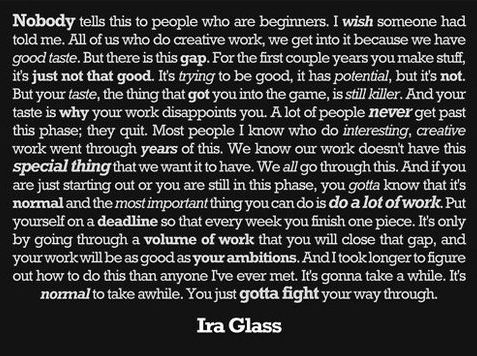
In the meantime, I've hung the quotation below on my wall to remind me I need to keep fighting.


Thursday, October 27, 2011

Fix It and Forget It: A Confidence Process

Fix-it and Forget-it does a lot of things right. Did you know the creator of the popular cooking series, according the website, is "especially concerned for those who don't have enough time to cook, as well as those who lack the confidence to cook."

I was thinking that we as writers fit this category. Subsititute "cooking" for "writing" and the sentence looks like this: "especially concerned for those who don't have enough time to write, as well as those who lack the confidence to write." Pretty fitting.

Fix-it and Forget-it prides itself on the concern it has for those who don't have enough time. Writer's never have enough time. There is always something that comes up to distract us--and we are easily distracted, even by our own thoughts. The other goal, the lacking confidence one, is so valid. We doubt many of the words we write--that's why we do so many revisions before we share it. Or we share it as we go so people can give us encouragement. I'm guilty of both areas, depending on the project.

Confidence to writers is a double-edged sword. If you have too much, you aren't as willing to listen to advice. If you don't have enough, you could find yourself face-down in a corner somewhere, your words in shreds on the floor.  Confidence is something every author needs to suceed (whether you are writing book #1 or #101) and it is the first thing to be lost at signs of trouble.

Fix-it and Forget-it is on to something. I'm sure that once Sally (our new pretend friend) cooks a few successful dishes, her confidence increases. Sally will branch out and try new things. If she ruins the dish, then she will probably feel like she will never be able to cook anything, ever. Sally has two choices: eat fast food until she dies OR figure out what she did wrong.  So, Sally will retrace her steps. Maybe she will re-read the ingredients. She can check the timer. She can even just try it all over again. There are many other options but the point is that Sally can figure out what happened--but she has to try to succeed first. And sometimes, she has to fail.

The same can be applied to writing. If you write a good scene then you are ready to write another one...and another. If you write a bad scene, it's so easy to go to Twitter instead. It's this time when you need to figure out the problem. Maybe your character is off or a motivation is missed. Maybe she the last sentence she said was completely wrong. Maybe he wants to go here instead of here. You can always figure out the problem--but you have to write something first. Life is a series of trial and error but eventually, Sally will cook something that tastes good and you will figure out where you need to go next.

What if you have tried--and failed? What then? Well,  Fix-it and Forget-it still applies.

I love my crockpot. I love finding recipes and adjusting them--or making up new ones with whatever I have on the shelf. When I use it, I gather all the ingredients and throw them in the pot. Let them simmer, cook all the way through and then go with it. There's no fear of messing it up, because you're just experiment. Maybe you should try this. Take your plot, characters, arcs, ideas--let them all simmer together. Play around with them. Toss in other things. Remove some things. See what happens. You can't mess it up, because you have the original recipe. The worst that happens? It doesn't work. The best? It does.

Is this post instilling confidence in you? It should. (At the very least you should be getting hungry!)

The whole purpose of this Fix-it and Forget-it franchise is to show people who don't know how to cook that they can, in fact, cook. The plan isn't that they will always use the crock-pot to cook every meal, but that they will have the confidence to grow and move beyond that and to something else.

When you have the confidence and drive to start writing, eventually you should have the confidence to continue writing. And to grow in your writing skills, pursuits and challenges. It's like learning to walk. It doesn't start there. We scoot, we crawl, we walk, we run. If we didn't have all the other steps before it, we'd never have the confidence to run. Confidence is slow building, but totally needed if you want to succeed. One great way I've found to build confidence is in other writers, through being challenged and encouraged.

Christina and I became CP's as I finished the first draft of my first-ever-official novel. She was so good at all the things I struggled with. She could pull a description out of something I wrote and ask me to go deeper and explain things I didn't even see as relevant. "It's so awesome!" I would say. But it wasn't. I could look at Christina's WIP and show her the things that weren't adding anything to the story. We both learned from each other and now I can (usually) write descriptively with more ease. (Note: Ease isn't always confidence. I tend to make Patricia read the really descriptive scenes as I write them. When you struggle with something, it's always worse in your head. I still think they suck and need the encouragement that they don't! Confidence is a slow process, just like with the crockpot!)

Chime in! 
  • What are some areas in writing you need to build confidence? 
  • What are some areas you are confident enough in? 
  • Are their people around you struggling in some areas that you excel? 
  • Can you help each other build confidence in these areas? 
  • What are some things in your project that you can apply the "fix and forget" method to?

Thursday, October 20, 2011

Some Things You Should Know About NANOWRIMO

November is the bane (or joy) of every writer's existence. It's the time when nation-wide, all the people buckle down and attempt to write 50,000 words of a novel. Some authors/writers/agents/etc love NaNoWriMo. (National Novel Writing Month) Some hate it. Some have no opinions--at least none they're willing to voice.

Whatever your opinion of NaNoWriMo, it doesn't matter. It's a GREAT challenge for anyone who calls him/herself a writer.

Why? Quite simply: it makes you write.

There's a way to track your progress in pretty little charts. Other people get to actually see what you're doing and if you're writing. There's encouragement, accountability, persistence--all the things we talk about on Tangled. Sometimes, you won't finish--because 50K in 30 days is kind of crazy. Honestly. When we attempt it, we're basically saying "I have no experience in hiking but I'm going to climb this mountain and not die." Especially when you have other things going on in your life.

But there's something about attempting that's so fulfilling. And then, on the off chance you succeed---well. That's just about one of the coolest things ever.

Last year was my first year doing NaNoWriMo. And guess what? I won! *insert happy dance here* The problem with that is when I look my life this year, I'm not quite sure that I will win again. There's just so much going on with school, work, life, and all the things in between. I know the odds of me winning  have decreased. I know it will be a treacherous hike. I know that I have a massive 10-12 page paper, plus my normal homework, plus the Spooktacular all happening in the next three weeks.

Maybe attempting NaNo is already labelled a disaster. But you know what? I don't even care!

So why am I telling you all this? A few reasons.

1) Patricia and I are both doing NaNo. We'll be talking about it on the blog through November. If you are participating, you should add us! We want to connect with you. I'm @danielleewrites on NaNo site and Patricia is @patriciaeriley.

2) Even if you don't participate, there's still A TON of good writing advice out there about NaNo and writing and all the things in between. Here are some things I found last year that you may find useful, encouraging and challenging whether you're doing NaNo or not.


Writing Prep for NaNoWriMo from Persephone Magazine
Rules for Writers from the late L.K. Madigan (Mermaid's Mirror, Flash Burnout)
You Gotta Believe from Myra McEntire (Hourglass)
My Pro-NaNo Rant from Julie Kagawa (The Iron Fey series)
Remember to Suck from poet E. Kristen Anderson
Why NaNoWriMo Rocks My Life by Courtney Allison Moulton (Angelfire)

3) It makes you think about what you want, when you want to do it and how you will accomplish it. We do weekly check-ins, but think of this is a monthly check-in. Set a goal and do everything you can to achieve it. Even if it seems crazy. It may be crazy, but that doesn't mean it won't be fun.

4) I really wanted an excuse to post this video. Because I love it. So much.


Are you participating in NaNo? If so, leave us your username so we can find each other!

What are some goals you have for November?